Appendix III: Storytelling
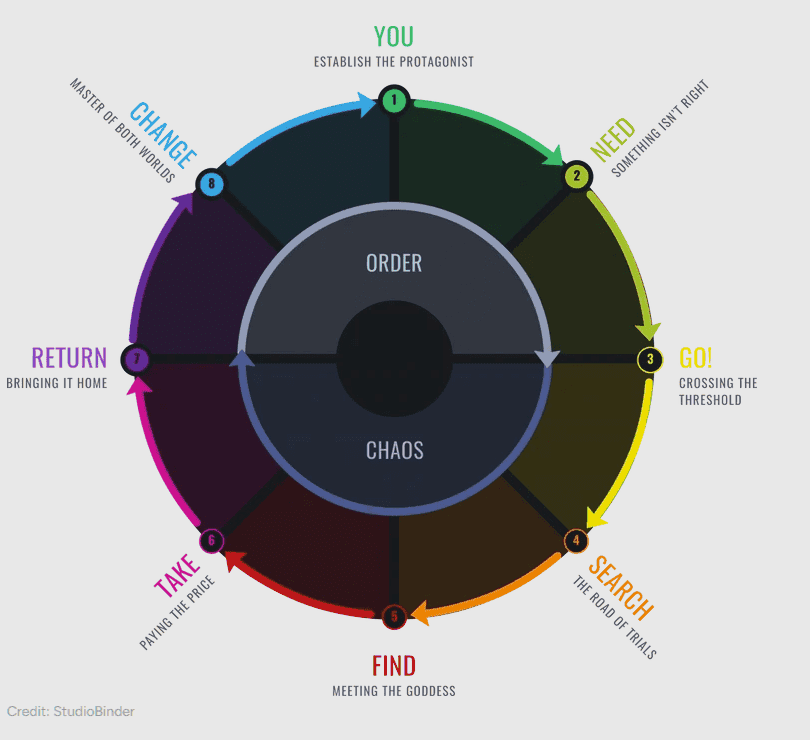
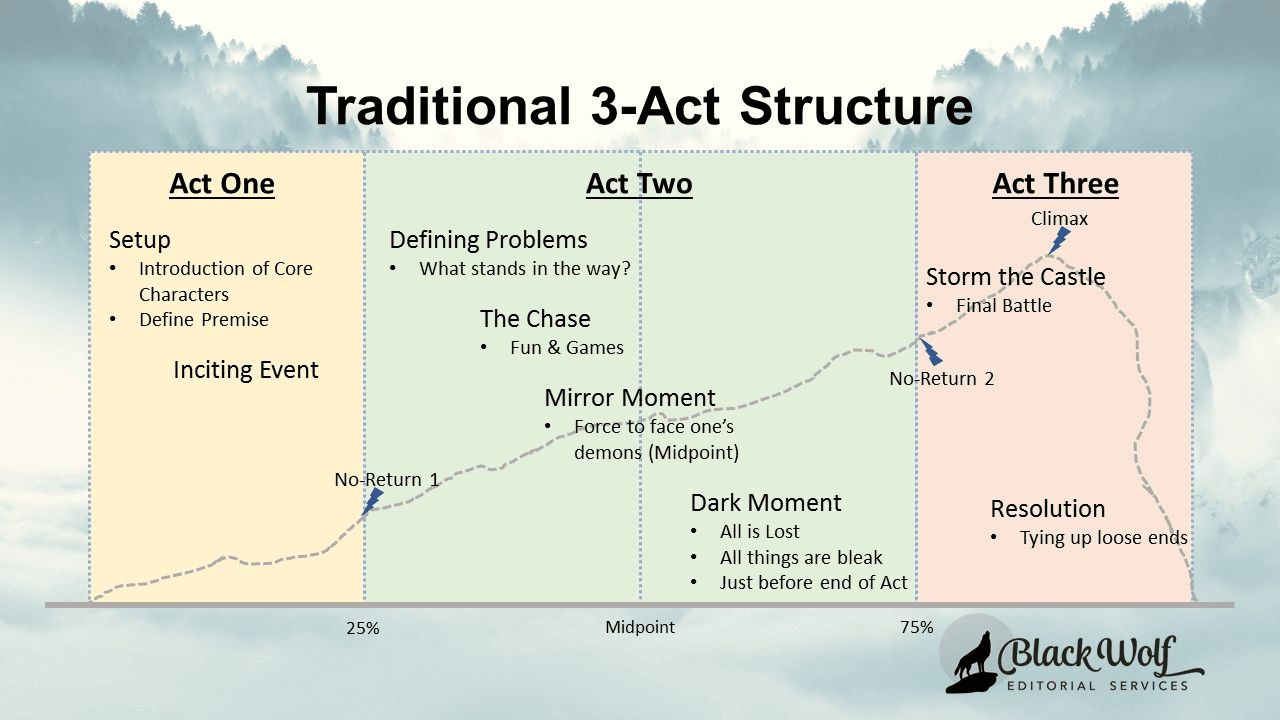
You might think that storytelling is a mysterious art. But good storytelling is actually a science that is well understood. There are two patterns that help explain how to form a good story. These patterns are the Steps of a Story and the Three Act Structure. All good stories from ancient times to modern movies generally use some form of these patterns. Furthermore, these can be put together to make a unified pattern.
The Steps of a Story
- You: A character is in a zone of comfort - The protagonist starts in a familiar, comfortable situation or environment.
- Need: But they want something - The character desires something or has a goal they want to achieve.
- Go: They enter an unfamiliar situation - The protagonist leaves their comfort zone and enters a new, unfamiliar situation or environment.
- Search: They adapt to it - The character learns to navigate and adapt to the new situation or environment.
- Find: They get what they wanted - The protagonist achieves their goal or obtains what they desired.
- Take: They pay a heavy price for it - The character faces consequences, challenges, or losses due to, achieving their goal.
- Return: Then return to their familiar situation - The protagonist returns to their initial familiar situation or environment.
- Change: But they are now changed - The character has grown, learned, or changed as a result of the journey and experiences.
Structure of the Story: The Three Act Structure
The Keys to an Engaging Story
- Hook / Setup:
- Capture the audience's interest by introducing a question or mystery.
- Provide a taste of what is to come and set the stage for the story.
- Inciting Event:
- Introduce the main challenge or conflict of the story.
- Present the call to adventure, and the protagonist chooses to embark on the journey.
- First Point of no Return / Plot Point:
- A significant event that fully commits the protagonist to face the obstacles.
- The point of no return, where the stakes are raised, and backing out is no longer an option.
- Rising Action / 1st Pinch Point:
- Introduce the first major obstacle the protagonist faces.
- Establish the stakes of the conflict and the potential consequences of failure.
- Foreshadow the impending catastrophe.
- Midpoint:
- A major turning point that challenges the protagonist's worldview.
- Reveal the full nature of the conflict, forcing the protagonist to switch from reactive to active.
- Second Point of no Return:
- Present a continued obstacle that emphasizes the antagonist's power.
- Set up and foreshadow the major showdown and the false victory that will lead to the low point.
- Third Plot Point:
- Usher the story into the final act with a false victory followed by the protagonist's lowest moment or darkest hour.
- Reveal that the cost of victory is higher than anticipated, leading the protagonist to have to start to change to be able to face the real extent of the challenge.
- Climax:
- The final confrontation where everything is at stake.
- The protagonist undergoes a significant change, becoming who they needed to be.
- The resolution clearly follows the climax, and the best stories relate the climax to the lesson or theme.
Now merge the two.
Integrated Structure: Dan Harmon's 8 Step Story Circle within the Three Act Structure
Act 1: Setup and Departure
- You (Hook/Setup): Introduce the protagonist in their comfort zone, establishing their everyday life and setting the stage for the story. Capture the audience's interest by introducing a question or mystery that hints at the upcoming journey. Provide a taste of what is to come.
- Need (Inciting Event): Present the protagonist's desire or goal, which disrupts their comfort zone. Introduce the main challenge or conflict of the story, presenting the call to adventure. The protagonist chooses to embark on the journey.
- Go (First Point of No Return/Plot Point): The protagonist leaves their familiar situation and enters an unfamiliar world or situation. This significant event fully commits the protagonist to face the obstacles ahead, raising the stakes and eliminating the option to turn back. It is the point of no return.
Act 2: Confrontation and Transformation
- Search (Rising Action/1st Pinch Point): The protagonist adapts to the new situation, learning to navigate the unfamiliar environment. They face the first major obstacle, establishing the stakes of the conflict and potential consequences of failure. This section foreshadows the impending catastrophe.
- Initial Find (Midpoint): The protagonist achieves a significant milestone or obtains what they desired. This major turning point challenges the protagonist's worldview, revealing the full nature of the conflict and forcing them to switch from reactive to active.
- Final Find (Second Point of No Return): The protagonist faces a continued obstacle that emphasizes the antagonist's power. This sets up and foreshadows the major showdown and the false victory that will lead to the low point.
- Attempted Take (Third Plot Point): The protagonist attempts to take what they need but fails due to the antagonist's power, leading to their lowest moment or darkest hour. This ushers the story into the final act, revealing that the cost of victory is higher than anticipated. The protagonist must start to change to be able to face the real extent of the challenge.
Act 3: Resolution and Return
- Successful Take and Change (Climax): The final confrontation takes place, where everything is at stake. The protagonist undergoes a significant change, becoming who they needed to be to overcome the challenges.
- Return (Resolution): The protagonist returns to their familiar situation, but they are now transformed by their experiences. The resolution clearly follows the climax and ties into the story's central lesson or theme. The best stories relate to the climax to the lesson or theme.
Story of Hagar
Using Dan Harmon's 8 Step Story Circle:
- You: Hagar, an Egyptian maidservant, lives in the household of Abram and Sarai, serving as Sarai's handmaid. This is her familiar, comfortable environment.
- Need: Sarai, being barren, desires a child. She offers Hagar to Abram as a surrogate to bear a child on her behalf, disrupting Hagar's comfort zone.
- Go: Hagar conceives a child with Abram, entering a new, unfamiliar situation as the mother of Abram's child and facing a change in her status within the household.
- Search: Hagar navigates her new role as a pregnant woman and the mother of Abram's child, facing challenges such as Sarai's jealousy and mistreatment.
- Find: Hagar gives birth to Ishmael, fulfilling Sarai's initial desire for a child through Abram and achieving the goal of becoming a mother herself.
- Take: As a consequence of giving birth to Ishmael, Hagar faces increased mistreatment and jealousy from Sarai, especially after the birth of Isaac, Abram's son with Sarai. This ultimately leads to Hagar and Ishmael's exile into the wilderness.
- Return: After God's intervention and promise to make Ishmael a great nation, Hagar and Ishmael settle in the wilderness of Paran, returning to a more familiar nomadic lifestyle.
- Change: Hagar has grown and changed throughout her journey, learning to rely on God and gaining a new understanding of her purpose and her son's destiny. She has transformed from a servant to a mother and a woman with a divine promise for her son's future.
Now look at it in an integrated story structure using both the 8-step story circle and the three structure act.
Act 1: Setup and Departure
- You (Hook/Setup): Hagar, an Egyptian maidservant, lives in the household of Abram and Sarai. Her role as a servant is established, setting the stage for the upcoming events and hinting at the potential for change in her status.
- Need (Inciting Event): Sarai, unable to conceive, offers Hagar to Abram as a surrogate to bear a child on her behalf. This decision disrupts Hagar's life and presents the main challenge of the story, as Hagar must navigate her new role and the consequences that follow.
- Go (First Point of No Return/Plot Point): Hagar conceives a child with Abram, marking a significant turning point in her life. She enters a new reality as the mother of Abram's child, fully committing her to face the challenges ahead and eliminating the possibility of returning to her previous role.
Act 2: Confrontation and Transformation
- Search (Rising Action/1st Pinch Point): Hagar, now pregnant, faces mistreatment from Sarai due to jealousy. She flees into the wilderness, where an angel of the Lord instructs her to return and submit to Sarai. This obstacle establishes the stakes of the conflict and foreshadows the impending challenges Hagar will face.
- Initial Find (Midpoint): Hagar gives birth to Ishmael, fulfilling Sarai's desire for a child through Abram. This milestone reveals the full nature of the conflict between Hagar and Sarai, challenging Hagar's worldview and forcing her to take a more active role in her own story.
- Final Find (Second Point of No Return): As time passes, Hagar and Ishmael face continued mistreatment, especially after the birth of Isaac, Abram's son with Sarai. This obstacle emphasizes Sarai's power over Hagar and sets up the major showdown that will lead to Hagar's lowest point.
- Attempted Take (Third Plot Point): Sarai demands that Abram cast out Hagar and Ishmael, leading to their exile in the wilderness. Facing the threat of death, Hagar reaches her darkest hour. She must begin to change and rely on God to face the true extent of the challenge before her.
Act 3: Resolution and Return
- Successful Take and Change (Climax): In the wilderness, Hagar and Ishmael face the brink of death from thirst. Hagar undergoes a transformative change, fully relying on God, who provides a well of water and promises to make Ishmael a great nation. This divine intervention marks the climax of Hagar's story.
- Return (Resolution): Hagar and Ishmael settle in the wilderness of Paran, where Ishmael grows up and becomes an archer. Although they do not return to their previous home, they find a new sense of belonging in their transformed lives. The resolution ties into the story's central theme of God's providence and faithfulness in the face of adversity.
________________________________________________________
Now let's look at the Story of Moses
Act 1: Setup and Departure
- You (Hook/Setup): Moses, a Hebrew raised as a prince in Pharaoh's palace, lives a life of luxury and privilege in Egypt. Despite his comfortable surroundings, he is haunted by the knowledge of his true identity and the suffering of his people under Egyptian oppression. This internal conflict sets the stage for his upcoming journey.
- Need (Inciting Event): Moses witnesses an Egyptian overseer brutally beating a Hebrew slave. Outraged by this injustice, Moses kills the overseer in a moment of passion. This act of defiance disrupts his comfortable life and forces him to confront the harsh reality of his people's enslavement, compelling him to take action.
- Go (First Point of No Return/Plot Point): Fearing retribution, Moses flees Egypt and enters the unfamiliar world of the Midian wilderness. This marks a significant turning point in his life, as he leaves behind his identity as a prince and begins his transformation into a humble shepherd and future deliverer of his people.
Act 2: Confrontation and Transformation
- Search (Rising Action/1st Pinch Point): During his time in Midian, Moses adapts to his new life as a shepherd, marries Zipporah, and starts a family. However, he remains haunted by the plight of his people back in Egypt. The burning bush encounter with God serves as the 1st Pinch Point, where Moses is called to return to Egypt and confront Pharaoh, setting the stage for the impending conflict.
- Initial Find (Midpoint): Moses returns to Egypt, armed with God's power and the support of his brother Aaron. He confronts Pharaoh and demands the release of the Hebrews, initiating a series of divine plagues that demonstrate God's supremacy over the Egyptian gods. This midpoint marks a shift in the power dynamic, as Moses begins to fulfill his role as a deliverer.
- Final Find (Second Point of No Return): Despite the plagues, Pharaoh refuses to release the Hebrews, leading to the tenth and most devastating plague – the death of the firstborn. This final act of divine judgment breaks Pharaoh's resolve, and he finally allows the Hebrews to leave Egypt. The Exodus begins, marking a point of no return for Moses and his people.
- Attempted Take (Third Plot Point): As the Hebrews depart Egypt, Pharaoh changes his mind and pursues them with his army, trapping them at the edge of the Red Sea. This moment of despair serves as the lowest point for Moses and the Hebrews, testing their faith in God's deliverance and foreshadowing the ultimate climax of their journey.
Act 3: Resolution and Return
- Successful Take and Change (Climax): At God's command, Moses stretches out his staff, and the Red Sea miraculously parts, allowing the Hebrews to cross on dry land. When the Egyptian army attempts to follow, the sea closes in on them, destroying Pharaoh's forces. This climactic event marks the ultimate victory of God's power and the fulfillment of Moses' role as the deliverer.
- Return (Resolution): On the other side of the Red Sea, Miriam leads the Hebrews in a joyful song of praise, celebrating their newfound freedom and God's triumph over their oppressors. This emotional return to worship and gratitude highlights the transformation of Moses and his people, as they emerge from the shadow of slavery into the light of divine deliverance. The story concludes with a sense of hope and promise, as the Hebrews set out on their journey to the Promised Land, forever changed by their experiences and their renewed faith in God.
__________________________________________________________
See how you can even do the Meta-Narrative of the Bible
Act 1: Setup and Departure
- You (Hook/Setup): In the beginning, God creates a perfect world and places Adam and Eve in the Garden of Eden, where they enjoy a harmonious relationship with their Creator. This idyllic setting establishes the initial state of perfection and sets the stage for the impending fall and the need for redemption.
- Need (Inciting Event): The serpent tempts Eve, and both she and Adam disobey God by eating from the forbidden tree of knowledge. This act of rebellion fractures the perfect relationship between God and humanity, introducing sin and death into the world. Mankind now needs redemption and restoration, which they cannot achieve on their own.
- Go (First Point of No Return/Plot Point): God sets in motion His plan of redemption, making a covenant with Abraham and promising to bless all nations through his descendants. This marks the beginning of God's journey to redeem humanity through the nation of Israel, and the point of no return is reached when God delivers the Israelites from slavery in Egypt and establishes His covenant with them at Mount Sinai.
Act 2: Confrontation and Transformation
- Search (Rising Action/1st Pinch Point): The Israelites, as God's chosen people, must navigate their new identity and relationship with Him, adapting to His laws and trusting in His providence. The cycle of rebellion and consequences, such as the Babylonian captivity, serves as the 1st Pinch Point, setting up the stakes of the spiritual conflict and foreshadowing the greater challenges humanity faces in their relationship with God.
- Initial Find (Midpoint): At the midpoint of the biblical narrative, God sends prophets to call His people to repentance and foretell the coming of the Messiah. This turning point suggests that God's plan of redemption through the Messiah is within reach, but the Israelites' continued struggle with sin and disobedience reveals the full nature of the spiritual battle for humanity's soul.
- Final Find (Second Point of No Return): As prophecies unfold and anticipation for the Messiah grows, the stakes intensify, and the spiritual battle reaches a fevered pitch. The birth, life, and ministry of Jesus Christ mark the final find, as God's plan of redemption is put into action. The point of no return is reached when Jesus willingly goes to the cross, taking upon Himself the sins of the world.
- Attempted Take (Third Plot Point): The crucifixion of Jesus Christ marks the darkest moment in the biblical narrative, where it appears that sin and death have triumphed over God's plan of redemption. This apparent defeat sets the stage for the ultimate climax of the story and the final act of God's redemptive work.
Act 3: Resolution and Return
- Successful Take and Change (Climax): The resurrection of Jesus Christ marks the climax of the biblical narrative, as God's power over sin and death is fully demonstrated. This ultimate victory secures the redemption of humanity and marks a fundamental change in the relationship between God and man, as the way to salvation is now open through faith in Christ.
- Return (Resolution): Following the resurrection, the early church is born, and the gospel message spreads worldwide. Believers, transformed by faith in Christ, are called to live in obedience and trust in God. The Bible concludes with a vision of a new heaven and new earth in Revelation, where God dwells with His redeemed people for eternity. This final return to a perfect relationship between God and humanity brings the story full circle, fulfilling the promise of redemption and restoration that began in Genesis.
_______________________________________________________
Techniques on storytelling to Adults
Adults likely already have a strong framework that they filter their life experiences and ideas through. Stories both inform the brain about facts and engage the emotional and relational center of the brain. But they will not want the story to be too long, boring, or without application to their life.
You should understand that by using powerful words you are taking the listener on a journey to a different time and place. This can show the listener how a different framework can operate in a valid and relevant manner, even if their own framework is very different. This opens the mind to the story and concepts of God's word in a way that simply stating facts cannot do.
The storyteller should use descriptive language that creates a clear picture of the Biblical world, making the sights, sounds, and feelings of the characters come to life. By connecting big ideas and universal truths, the storyteller can make a story that really speaks to the audience, helping them see their own challenges in the lives of Biblical figures. The storyteller must also accurately create the characters in the minds of the listener by exploring the thoughts, fears, and wants of the main characters in a way that shows understanding and care of the life of the listener. By doing this, the storyteller can make a story that shows the Biblical experience in a way that the listener can relate to, no matter when or where they live, making the the Bible meaningful and relevant to people today.
To create a Biblical story that fully immerses the listener, the storyteller needs to be great at building a world and setting the mood that meets the key issues that the listener needs to hear. Simultaneously, the storyteller must also be a master of pacing and building tension, knowing when to take a moment to reflect and when to move the story forward. By carefully planning the rise and fall of the story, the storyteller can keep the audience engaged and invested in the narrative and impact their hearts. In addition to creating a story that fully immerses the listener and touches their emotions, the storyteller must also be skilled at demonstrating the deeper spiritual truths that are woven throughout the Biblical narrative. By shining a light on the big themes and lessons hidden within the text, the storyteller can invite the audience to wrestle with life's biggest questions and discover the life-changing power of God's Word.
When dealing with adults, the storyteller should not be afraid to explore the darker parts of human nature, from the lowest points of despair to the highest points of redemption, using the Biblical story as a way to look at the complexities of the human heart. At the same time, the storyteller must also be a source of hope and inspiration, reminding the audience of the lasting power of God's sovereign glory and His love and saving grace.
Lastly, the art of creating an engaging Bible story for adults requires an understanding of the audience itself. The storyteller must be in tune with the unique needs, concerns, and experiences of the listeners, shaping the story to speak directly to their hearts and minds. By creating a space for conversation and reflection, the storyteller can encourage the audience to engage with the text actively, bringing their own perspectives and insights to the ancient wisdom of the Bible. The storyteller must also be a master of adaptation, able to draw connections between the Biblical world and today, making the timeless truths of the Bible relevant and applicable to the challenges and opportunities of modern life.
Some key points for adults
- Use appropriately complex language and concepts:
- Adults will not feel respected if you use childlike language and storytelling forms.
- Employ appropriately advanced vocabulary, figurative language, and idioms when appropriate.
- When telling the story to an unbeliever or a new believer, be very careful in the use of Christian terms (e.g. "Propitiation" or "Sacrificial Lamb") unless you have to and have a way to explain the concept / term first. Do not assume they will know the meaning of terms that are familiar to you. A good way to introduce the term is to tell the story, or at least a short version of the story, which can itself explain the concept. Otherwise, try to convert the term into language that would be recognizable to the unbeliever's culture.
- Explore abstract concepts, symbolism, and metaphors within the story. But do it through leading questions, not dictation. Generate expectation... Expectation and tension, through the use of pacing and tone, are the key to good storytelling.
- Connect stories to real-life applications and modern-day relevance. Adults expect and need application to their real-life situation.
- Draw parallels between Biblical characters' experiences and contemporary challenges
- Highlight timeless principles and lessons that apply to modern relationships, careers, and personal growth
- Example: When telling the story of Esther, discuss how her courage and faith can inspire us to stand up for what is right in our own lives, even in the face of adversity.
- Encourage reflection and discussion to lead to interpretation. Don't just tell them the answer. Help them reach the conclusion through their own thinking.
- Pose thought-provoking questions that encourage introspection and sharing of personal experiences.
- Facilitate discussions to explore different perspectives of the story.
- Depending on the situation and context, provide historical and cultural background for deeper understanding
- In training environments, use maps, timelines, and visual aids to illustrate the geographical and historical setting of the story
- To help adults understand the details, you may have to explain cultural customs, social norms, and religious practices that shape characters' actions and decisions
- Example: When telling the story of Ruth, discuss the significance of gleaning, kinsman-redeemers, and Levirate marriage in ancient Israelite society
- Use storytelling techniques like voice modulation, pacing, and dramatic pauses. Just because they are adults, does not mean they want a boring story!
- Vary tone, pitch, and volume to convey different emotions and characters.
- Use strategic pauses and silence to build anticipation or allow for reflection.
- Adjust pacing to emphasize key moments and maintain engagement.
- Don't shy away from the truths of the Bible because they are hard. The Bible's truths are hard. Trust in the Holy Spirit to guide you in these things. BUT if you cover things up or lie about what the Bible actually says, you will lose your credibility and defame the Word of God.
_________________________________________________________________
Tips on storytelling with children
Children learn a great deal from stories, as they provide a powerful and engaging way to convey knowledge, values, and life lessons. Stories captivate children's imaginations, allowing them to visualize and emotionally connect with characters and situations that may be different from their own experiences. Through this connection, children can develop understanding and a broader perspective on the world around them.
Stories also help children understand complex concepts and ideas in a simplified, relatable manner, making it easier for them to grasp and remember the information being shared. Moreover, stories can inspire curiosity, creativity, and critical thinking skills that lead children to ask questions, predict outcomes, and be drawn to proper conclusions.
Children have short attention spans, limited vocabulary, and limited understanding of the world. They need clear and simple story lines with clearlessons. But do not shy away from theological truths just because it's children.
- Use simple, age-appropriate language and concrete examples
- Employ vocabulary and sentence structures that match children's developmental stage
- Use simple and everyday examples to illustrate abstract concepts in a concrete way that is relatable to children.
- Focus on key messages and moral lessons
- Emphasize one or two main points that children can easily grasp and remember. Too many issues will cause them to become confused and not learn.
- Highlight simple practical applications and takeaways relevant to children's lives
- Incorporate interactive elements, such as role-playing, props, and visual aids.
- Engage children through participatory storytelling, allowing them to act out scenes or respond to prompts
- Use colorful visuals, puppets, or simple costumes to capture attention and make characters more relatable
- Use engaging storytelling techniques like character voices, facial expressions, and gestures. Children have big imaginations. They will be able to engage much better in a story if you use dramatic and exaggerated sounds and motions.
- Create distinct voices for different characters to bring them to life
- Use exaggerated facial expressions and body language to convey emotions
- Incorporate simple, clear, but at times exaggerated gestures and actions that children can mimic
- Example: In the story of Zacchaeus, use a high-pitched voice for Zacchaeus and exaggerated surprise when Jesus calls him by name.
- Encourage participation through questions, predictions, and repetition
- Ask children to predict what might happen next or how characters might feel
- Use call-and-response or repeated phrases that children can join in saying. Children remember better through repetition.